
SEO for Beginners 2025: If you want your website to rank higher on Google, this step-by-step guide is for you.
Learn how to do keyword research, optimize your pages, create engaging content, and build quality links.
Even if you’re just starting out, these practical strategies will help you attract organic traffic.
By the end of this guide, you’ll understand how to implement SEO effectively in 2025.
- What Is SEO and Why It Matters
- How Search Engines Work (In Simple Terms)
- Step 1: Keyword Research — The Heart of SEO
- Step 2: On-Page SEO — Optimize What’s on Your Page
- Step 3: Technical SEO — Make Your Site Search-Friendly
- Step 4: Content Strategy — Create Content That Ranks
- Step 5: Link Building — Building Authority
- Step 6: Track and Measure SEO Performance
- Step 7: Stay Updated with SEO Trends in 2025
- Step 8: Common SEO Mistakes to Avoid
- Quick SEO Checklist
- Final Thoughts
- About the Author
What Is SEO and Why It Matters
SEO (Search Engine Optimization) is the process of improving your website’s visibility on search engines like Google.
When users search for a topic, Google ranks pages based on relevance, authority, and user experience.
SEO for Beginners 2025 is all about understanding these principles and applying them strategically to rank higher.
How Search Engines Work (In Simple Terms)
Before learning how to optimize, let’s quickly understand how Google decides which sites appear first:
- Crawling: Google bots discover new or updated web pages.
- Indexing: Pages are stored in Google’s database.
- Ranking: When a user searches, Google shows pages based on relevance, authority, and user experience.
If your website isn’t crawlable, indexable, or optimized, you’ll struggle to appear — no matter how good your content is.
Step 1: Keyword Research — The Heart of SEO
Every successful SEO campaign begins with keyword research.
Keywords are the phrases your audience types into Google.
For example:
- “how to do SEO step by step”
- “best SEO tools 2025”
- “SEO for beginners”
How to Do Keyword Research (Quick Guide):
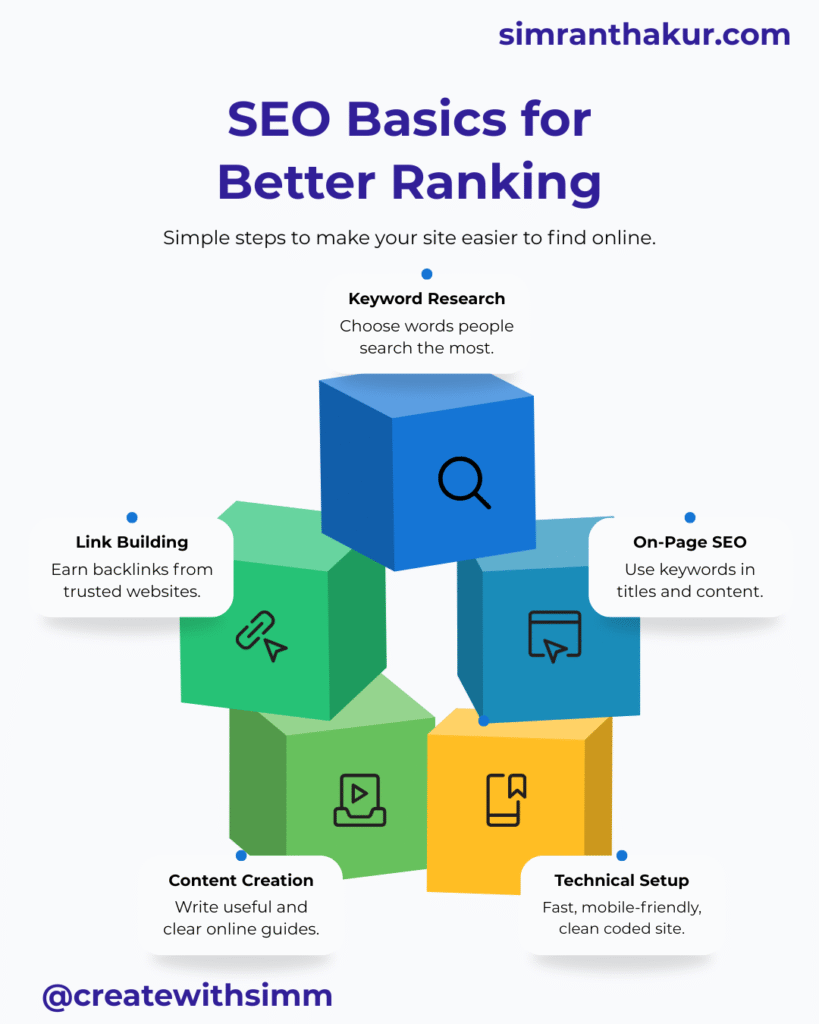
- Start with seed keywords related to your business.
- Use tools like Google Keyword Planner, Ubersuggest, or Ahrefs to find search volumes.
- Focus on long-tail keywords — specific phrases with lower competition.
- Group keywords by intent (informational, navigational, transactional).
Example:
If your keyword is “SEO for beginners,” related long-tail keywords could be:
- “learn SEO step by step”
- “SEO tutorial for new websites”
- “basic SEO tips for 2025”
Pro Tip: Always choose keywords that match what your audience wants to achieve, not just what has the highest volume.
Step 2: On-Page SEO — Optimize What’s on Your Page
On-page SEO means optimizing individual pages so search engines understand your content better.
Main On-Page Elements
- Title Tag: Use your primary keyword early.
Example: “SEO for Beginners: Complete Step-by-Step Guide (2025)” - Meta Description: Summarize your page in 150–160 characters, using keywords naturally.
- URL Structure: Keep URLs short and clean.
Example: www.yourwebsite.com/seo-for-beginners - Headings (H1–H3): Use one H1 (main keyword), and relevant subheadings.
- Content Optimization:
- Use keywords and synonyms naturally.
- Write for humans first, algorithms second.
- Add bold, italic, and underline to emphasize important terms.
- Images: Compress for speed and include alt text with descriptive keywords.
Example:
Instead of writing:
Learn SEO easily.
Write:
Learn SEO step-by-step with this complete beginner guide that helps you understand both Google ranking factors and user intent.
Step 3: Technical SEO — Make Your Site Search-Friendly
Even the best content won’t rank if your site is slow or broken.
Technical SEO Essentials
- Mobile-Friendly: 90% of users browse on mobile — your site must be responsive.
- Speed Optimization: Use tools like Google PageSpeed Insights. Compress images, use caching, and remove unnecessary plugins.
- Secure (HTTPS): Always have an SSL certificate.
- Crawlability: Ensure your robots.txt and sitemap.xml are configured properly.
- Structured Data (Schema): Helps Google understand your content type (articles, products, FAQs).
Think of technical SEO as the foundation of your house — it must be solid before decorating with content.
Step 4: Content Strategy — Create Content That Ranks
Your content is the soul of SEO. Without it, keywords and backlinks won’t help.
How to Create SEO-Friendly Content
- Match Search Intent: Understand what users expect when they search.
- Use Topic Clusters: Create a main (pillar) post like this one, and link related posts (e.g., keyword research, link building).
- Add Value: Give solutions, not filler text.
- Keep It Updated: Refresh your blog every 6–12 months with new examples or stats.
Example: A blog titled “SEO for Beginners 2025” should include updated insights about Google’s latest algorithms, not 2019 methods.
Step 5: Link Building — Building Authority
Links are like “votes” for your site. The more quality links you get, the higher your credibility.
Types of Links
- Internal Links: Between your own pages (help users and bots navigate).
- External Links: Linking to reputable sources builds trust.
- Backlinks: When other websites link to you — this boosts authority the most.
Safe Ways to Build Links
- Guest post on related websites.
- Create shareable resources (infographics, research).
- Use outreach (email or social) to share your guides.
- Avoid spammy tactics — Google penalizes low-quality or paid link schemes.
Remember: One backlink from a trusted site is worth more than 50 from random directories.
Want to learn how link authority actually flows through your website?
Read this complete guide — What Is Link Juice in SEO? How to Use It to Boost Your Website’s Authority — to understand how backlinks transfer SEO value and help boost your rankings.
Step 6: Track and Measure SEO Performance
SEO is a process — you can’t improve what you don’t measure.
Tools to Track Progress
- Google Analytics: Measure traffic, engagement, conversions.
- Google Search Console: Track keyword performance, clicks, and indexing.
- Ahrefs / SEMrush: Analyze backlinks and competitors.
Check metrics monthly to see which pages perform well and which need improvement.
Step 7: Stay Updated with SEO Trends in 2025
The SEO landscape changes every year. Here’s what to focus on in 2025:
- AI-Driven Search Results: Tools like Google Gemini and AI summaries mean your content must be clear, factual, and original.
- E-E-A-T (Experience, Expertise, Authoritativeness, Trust): Google rewards real experience. Add author bios and cite reliable data.
- Voice Search Optimization: Use conversational, question-based keywords.
- Zero-Click Searches: Optimize for snippets, FAQs, and schema.
Staying current keeps your content relevant and visible.
Step 8: Common SEO Mistakes to Avoid
- Stuffing keywords unnaturally
- Ignoring mobile and site speed
- Copying competitor content
- Skipping analytics or updates
- Expecting instant results — SEO takes time and consistency
Quick SEO Checklist
- Keyword-rich title and meta description
- Fast, mobile-friendly website
- Optimized headings (H1–H3)
- Proper internal linking
- Updated, original content
- Quality backlinks
- Schema markup added
- Analytics and tracking set up
Final Thoughts
If you’ve read till here, you now understand the full picture of SEO for beginners in 2025.
The truth? SEO isn’t about tricks — it’s about consistency.
Keep creating valuable content, optimize it thoughtfully, and measure results regularly.
Over time, you’ll see your website climb search rankings and bring in steady organic traffic.
In short —
Write for people. Optimize for Google. Update for 2025.
About the Author
Simran Thakur is a Digital Marketing Strategist who helps brands grow through smart SEO, content marketing, and digital strategy.
With a focus on practical growth and real results, Simran believes in building long-term digital ecosystems — not quick hacks.
If you prefer expert support instead of doing SEO alone, read this guide on How to Hire the Best Digital Marketing Agency for Your Business.
📩 Email: growwithsimranthakur@gmail.com / contact@simranthakur.com
🌐 Website: www.simranthakur.com
If you’re looking to grow your business through SEO and digital marketing, visit simranthakur.com to get personalized strategies that drive real results.